|
Forthcoming Meetings & Events
Our meetings are held in Nayland Village Hall, 7.15pm for 7.30pm start.
Everyone is most welcome. Entry is free.
| Tuesday
12th March 2024 |
AGM and and local author Mick Inkpen talking about his career as a writer and illustrator of
books for children.
The AGM ducuments can be found on the Membership
page |
| Sunday
9th June |
Open Gardens 2pm-6pm |
| Tuesday
25th June |
50th Anniversary Celebration with a special presentation by long standing members |
| Tuesday
8th October |
Nigel Amies speaking about the 'Home Guard' |
| Tuesday
12th November |
David Pryor will give a talk on the 'Sutton Hoo Ship’s Company' |
Recent Meetings
| |
|
| |
|
| |
Terry Bannister on 'Jósef of Lwów (Lviv)’
The story of her father, Józef
Pankiewicz, focusing on his life during the Second World War and
his traumatic experiences.
In September 1939 Hitler
and Stalin invaded Lwów, then part of Poland. In February 1940
Stalin transported many Poles, including Józef (15) and his family
on cattle trucks to labour camps in the Ural mountains, Siberia.
After 16 months of hard labour and terrible conditions, the Poles
who had survived were told that they were no longer prisoners as
Hitler had invaded Russia.
Józef and his family managed to escape from Siberia by train and a lot of luck
to the Middle East. Here Józef joined the newly formed Polish II Corps attached
to the 8th Army, but he had to leave his family behind. After training he went
to North Africa and eventually to Monte Cassino, Italy. After the War he settled
in England believing his whole family had perished. |
| |
|
| |
19th June 2023 |
| |
Sir Bob Russell gave a talk on 'Memories of Nayland'
Bob who is an enthusiastic historian and an experienced
speaker; was born and brought up in a house, since demolished,
near the foot of Gravel Hill.
He gave personal recollections of his youth
in the village and connection with renowned Nayland families
provided a very interesting evening. His brother David and playmates
of yesteryear, such as Roy Norfolk, John Spooner and Adrian Amos
were in attendance. |
| |
|
| |
6th March 2023 |
| |
Mark Wilkinson gave a talk on 'Stamp Design'
Almost 80 members and guests attended the Nayland Village Hall
for our AGM and thereafter to hear an excellent presentation
from talented local resident Mark Wilkinson who spoke on the
topic of postage stamp design. Mark is internationally famous
for his record sleeve illustrations and it was intriguing to
hear that he had designed so many stamps. |
| |
|
| |
3rd October 2022 |
| |
Edward Martin gave a talk on 'Suffolk’s Humphry Repton'
Members and guests of the Society were entertained and informed in equal measure
by Edward Martin with his presentation on the subject of “Suffolk’s Humphry
Repton”. It was surprising to hear how many landscape designs had been commissioned
in Suffolk and perhaps more astonishing Edward made it clear that Repton was
very frank (and indeed rude) about the inadequacies of some of the buildings
and estates which were the subject matter of his commissions. A significant
part of the presentation dealt with Repton’s “red Book” on the nearby Tendring
Hall Estate and it was a pleasure to see the Estate owner and her team in attendance
for the talk. |
| |
|
| |
Monday 7th March 2022 |
|
| |
Christ Hunt gave a talk on 'Industry in Nayland'.
After the official business of the AGM, Chris Hunt gave a memorable
talk on the history of industry in Nayland. He was assisted
by local resident
Peter Drew who read a number of quotes in a variety of accents
much to the amusement of the audience.
Chris is an entertaining speaker with a wealth of knowledge
on all aspects on Nayland and Wiston. His talk included various
industries over the years including the Wool industry, the
mills, farming, river barges, Norfolk's transport, et al.
|
| |
|
|
| |
Monday 8th November 2021 |
|
| |
Simon Hooton gave a talk on 'Swifts'.
Simon gave an excellent talk and his accompanying power point presentation
contained some stunning photography and many suggestions how we can all help
to halt the current decline in Swift numbers.
At this meeting we also screened the premiere of the film 'The
history of Nayland'. This film, which was shot by local cameraman Stuart Howells, was commissioned
by the Society but paid for by 25 members. |
| |
|
|
| |
Monday 4th October |
|
| |
John Taylor, an Energy Projects Manager for the Greater South East Energy Hub, a public sector team that works across the South East of England gave a fascinating talk on 'How to Live Net Zero in Rural Suffolk'.
This included the steps to be taken to reduce carbon emissions to slow up climate change. His recommendations ranged from the installation of air source or ground source heat pumps for domestic property heating to life style changes such as travelling by electric vehicle, coach or train rather than by flying. We were pleased to note that he made special mention of the community project relating to our local school which involved the installation of solar panels onto the school roof.
|
| |
|
|
| |
Monday 28th June 2021 |
|
| |
Peter Tatum gave a most interesting talk via Zoom on the Stour Valley Path.
Peter used some stunning photography for the Power Point presentation which accompanied his speech. |
| |
|
|
| |
Monday 8th March 2021 |
|
| |
Jeremy Greenwood gave a most interesting talk via Zoom on 'John Nash RA'
The Society’s AGM on the 8th of March was was a great success with over 50 members in attendance. Jeremy Greenwood, an author of a book on John Nash, gave a most interesting talk on John Nash’s life in the Stour Valley with some superb illustrations. |
| |
|
|
| |
Meetings during 2020 |
Unfortunately it was not possible to hold our planned speaker meetings in the village hall due to the Covid-19 pandemic.
However, on 23rd November Rick Lewis gave an excellent talk via Zoom on the topic of “How we built timber framed buildings in the 15th to 17th centuries".
|
| |
Moday 9th December 2019 |
|
| |
The Court Knoll Project: an update on findings from lead archaeologist Jo Caruth.
On Monday evening the 9th December at Nayland Village Hall Archaeologist Jo Caruth entertained a large audience of members, guests and visitors with the latest developments on the Court Knoll Project.
In his introduction, Chairman Mike Hunter thanked the Sustainable Development Fund of the Dedham Vale AONB and Stour Valley Project for their unstinting support. The Fund have awarded a grant to the Society for each of the past four years and have contributed a total of £12,664 towards the total costs incurred to date of £33,000. The manager of the Dedham Vale AONB Project, Simon Amstutz made a brief response modestly acknowledging the support given to the Society.
In her talk Jo Carruth gave a summary of the history of the site and the excavations organised by the Society and also referred to the latest developments arising from the expert analysis of glass and charcoal.
In the report on the glass fragments the expert concluded that “the Court Knoll glass is a forest type glass…..it is very unusual in several respects and no exact match has been found for it……….the glass is perhaps from the 13th Century or slightly earlier, in which case this is a rare early example of the use of Forest Glass in England. Glazing for the Palace of Westminster was procured at this time and any contemporary glazed buildings would also have been of similar status”.
The charcoal expert reported that ”the absence of evidence of beetle tunnels……indicates that the wood was not heavily decayed at the time of burning; implying that the chapel was not deliberately demolished due to age or poor condition……..the small size and shape of the pieces suggest some form of decoration or carving detail……..and that carved motifs or something similar extended around the chapel”.
Bearing in mind the existence of the late Saxon polychrome tile (previously reported) the addition of these latest disclosures lend support to the theory that this Anglo-Saxon chapel may have been of very high status. Further expert analysis continues apace and news will be released as and when appropriate. |
| |
|
|
| |
Monday 11th November 2019 |
|
| |
Steve Piotrowski on Barn Owls
The November meeting, co-hosted with the Horticultural Society on 11th November 2019, received a talk on the topic of Barn Owls from Steve Piotrowski, a very well-respected lecturer in the birdwatching community.
Steve’s breadth of knowledge was extraordinary and it was of little surprise to learn that he is a published author and environmental consultant. |
| |
|
|
| |
Monday 7th October 2019 |
|
| |
Dr. Nick Amor gave an impressive talk to around 50 members and guests on the topic of the Suffolk Medieval Cloth Industry on 7th October.
Wool was by far the most important influence on European trade in the late 12th to early 14th century and during this period an industrial revolution took place which saw the manufacture and export of woven cloth from the wool towns replace the export of raw wool. As trade developed the area became a very attractive cloth weaving centre, both in terms of silk and wool. The development of this trade generated huge wealth for those involved and this manifests itself today in the legacy of fine buildings which are a feature of Wool Towns. Today, the Wool Towns retain their medieval centres, streets lined with timber-frame buildings and elegant churches filled with light.
By referring to the number of court actions conducted at the time Nick was able to identify the most successful wool merchants and their location. Nick also reviewed a substantial number of wills which once again helped to identify the wealthier clothiers and traders. It was astonishing to realise that for a period a small area of mid and south Suffolk was among the most wealthy and successful wool industry areas in Europe. This fortunate position arose not because of the quality of the wool produced locally (which was on the low side) but the easy access of the Hanseatic League traders via the ports of Ipswich and Colchester. |
| |
|
|
| |
Monday 24th June 2019 |
|
| |
Sarah Cook on Cedric Morris Artist and Plantsman
Over 60 members and guests of the Society met at Nayland Village Hall on 24th June to hear Sarah Cook speak on the extraordinary work of internationally renowned artist Cedric Morris in connection with the breeding of Bearded Iris.
After an initial summary of Cedric’s early life, including his establishment as a significant artist and the creation of the Dedham School of Art, Sarah concentrated on his horticultural work. Sarah reported that from the early Forties onwards, he was raising 1,000 seedlings a year by hand-pollination; sifting and assessing them for vigour and form and using his artist's eye to produce painterly colours, including pioneering soft pinks and muted yellows. Many of these plants have been lost but Sarah has spent a huge amount of time and effort tracing them and there are now only a few which remain to be found. |
| |
|
|
| |
Monday 11th March 2019 |
|
| |
AGM: John Morris gave a talk on The River Stour Trust
A healthy number of members and visitors attended this year’s AGM on the 11th of March but not our Chairman who had been laid low by a virus and accordingly committee member John Partridge conducted proceedings. It was reported that after many years of service, former Chairman John Alexander had resigned from the committee as also had Ed Fehler and both received a round of applause from the audience in appreciation of their efforts. Unfortunately, Life President Barry Wakefield had also been unable to attend the meeting through ill-health so John Alexander stood in to deal with the election of the committee for the year 2019-20. The committee membership is as follows: Mike Hunter Chairman; Jill Slater Hon. Secretary; Martin Wright Vice-Chairman; David Heigham Treasurer and committee members Tom Gardiner, Lucy Carpenter, Suzanne Cullen and Frank Warren.
Following the formal business of the evening the guest speaker, John Morris Chairman of the River Stour Trust, addressed the audience with a most enjoyable history of the River Stour Navigation, illustrated with a wide range of photos, some of which came from the Society’s own collection.
John Alexander gave an appreciative vote of thanks at the end of the meeting. |
| |
|
|
| |
Monday 12th November 2018 |
|
| |
Joint meeting with Nayland & District Horticultural Society: speaker Dougal Urquhart on The Perils of Bird Migration
The topic of the perils of bird migration was graphically explained by Essex County Council ranger Dougal Urquhart who has a lifetime’s interest in ornithology. Aided by some excellent slides, Dougal gave a convincing explanation for the reduction in some bird numbers, citing a number of reasons including global warming. However, the direct influence of mankind was also playing its part, especially in western Europe where intentional bird trapping and game shooting was having a drastic effect on migrating bird numbers. On a more positive note Dougal mentioned the events of the 3rd September 1965 when the largest ever influx of migrating birds was recorded. A sudden change in weather conditions caused at least 200,000 foreign wheatears, redstarts, warblers and flycatchers to descend upon the reserve. In all fifty-two species of birds were recorded. |
| |
|
|
| |
Monday 8th October 2018 |
|
| |
Peter Minter speaking on The Bulmer Brick and Tile Company
At our open speaker meeting on the 8th October around seventy members and guests were entertained by Peter Minter of the Bulmer Brick and Tile Company. Supported by a fascinating array of photographs showing the type of work carried out by his company Peter explained that the seams from which the clay is extracted had been used intermittently since roman times. His company was founded by his father in 1936 and four generations of the family have now been employed in its service. As a high degree of skill is required to design bricks to match the pattern and style necessary for ancient buildings the Company has acquired an international reputation and has received commissions from as far away as Australia.
Nearer to home, bricks have been supplied to Hampton Court and St Pancras Station and even closer to Nayland, Peter’s company has repaired the chimney stack at Thorrington Hall and assisted in the restoration of Freston Tower, a Landmark Property overlooking the River Orwell. Over 90% of the buildings that Peter’s company work upon are listed at Grade II or above.
Peter has written and published a book about his experiences and a number of copies were purchased on the evening by his appreciative audience. |
| |
|
| |
25th June 2018 |
|
| |
Bill Sargent on 'Pargetting'
The Society held its second open meeting of the year and received a talk on the subject of pargetting from the hugely experienced Bill Sargant and his colleague Andrew Fawcett. The artistic skill demonstrated by both Bill and Andrew was breathtaking. They do not use moulds but free draw the design on the wall or ceiling before applying limeplaster. Bill presented a substantial number of photographs showing the work carried out by him and his colleagues, which demonstrated the vast range of subjects and many techniques that they use to produce such fine work. |
| |
|
|
| |
13th March 2018 - AGM |
|
| |
Mark Bills, director of Gainsborough House in Sudbury, on 'Gainsborough and propsals for Gainsborough House'
Despite an appallingly wet evening, attendance was excellent at the Society’s AGM on the 12th of March. Following the usual business of approving accounts and re-appointing the chair and committee, the audience were shown the plaque commemorating the efforts of Richard Wiles who has undertaken so much voluntary work in Horkesley Lock and Richard’s Wood. Sadly Richard was unable to attend the meeting to receive his well-deserved recognition.
After the formal part of the evening was over, Mark Bills, the director of Gainsborough House in Sudbury, gave a superb lecture on Gainsborough followed by an explanation of the proposed development at Gainsborough House. |
| |
|
|
| |
Monday 13th November 2017 |
|
| |
Joint meeting with Nayland & District Horticultural Society: Pip Wright, on 'Whistlecraft: notorious poachers of Rickinghall Suffolk'
On the 13th November, in a joint speaker meeting with the Horticultural Society, members and guests were entertained by Mr. Pip Wright who regaled us with fascinating stories concerning the poachers of Rickinghall, a village in Suffolk. In a most unusual presentation Pip adopted the identity of Joe Whistlecraft who had been active in the first half of the 20th century; he had been tried and acquitted of the murder of a gamekeeper and in the latter part of his life fulfilled the idiom of poacher turned gamekeeper by becoming a gamekeeper. |
| |
|
|
| |
Monday 9th October 2017 |
|
| |
Dr James Bettley, on 'The New Suffolk Pevsner'
On the evening of the 9th October around 80 members and visitors enjoyed a presentation from Dr. James Bettley the author of the latest edition of Pevsner’s Buildings of Suffolk. In the course of his research he gained access to Nicholas Pevsner’s papers, which gave rise to many amusing anecdotes including the revelation of his fondness for Suffolk Cider. In addition to the volumes of Suffolk East and West, James is the author of the latest Essex edition and is currently working on Hertfordshire. Notwithstanding the fame of these publications it is surprising that James still encounters difficulty in viewing some of the properties included in the listing. |
| |
|
|
| |
Monday 26th June 2017 |
|
| |
Darren Tansley, Essex Water for Wildlife officer, on 'Otters and the River Stour'
Around 70 members and visitors attended our Open Meeting at Nayland Village Hall on the 26th June where we received an excellent presentation from Darren Tansley of the Essex Wildlife Trust. Following the natural return of Otters to the Stour, primarily as a result of the banning of harmful pesticides, an established population is once again present, although they are rarely seen. Unfortunately the A134 at Nayland has been the site of a number of fatalities but nevertheless evidence of the continued existence of this fascinating animal is regularly found on the riverbank through the discovery of Otter spraints (droppings). |
| |
|
|
| |
13th March 2017 - AGM |
|
| |
Francis Terry on 'Architecture and Design in AONB’s'
During the AGM warm tributes were paid at the meeting to Andora Carver who retired after 30 years as secretary. ike Hunter said her resignation brought to an end three decades of work and dedication, the like of which would not be seen again.
President and former chairman Barry Wakefield said his years of working with Mrs Carver had given him great pleasure. Her thoroughness and enthusiasm had made a massive contribution to maintaining and developing the society.
Another former chairman John Alexander said during day to day dealing with potential adverse developments, particularly the Horkesley Park scheme which lasted more than 10 years, Mrs Carver had shown a “steely reserve” and the village owed her a massive debt.
On the society’s behalf he presented her with a dual five-year membership of the Royal Horticultural Society. In her response Andora said the society had achieved a huge amount over the years, culminating in the Court Knoll dig and it had been a great privilege to be part of it.
Following the AGM internationally renowned architect Francis Terry informed and educated an appreciative audience in equal measure as he spoke in defence of neo classical architecture against the allegation of “pastiche” design. A fascinating array of slides showed some of the impressive buildings designed by him and his father and also gave unusual examples of new art forms absorbing and transforming historical influences. His talk prompted an invigorating question and answer session demonstrating the interest he had engendered in his talk. The vote of thanks was given by immediate past Chairman John Alexander. |
| |
|
|
| |
14th November 2016 |
|
| |
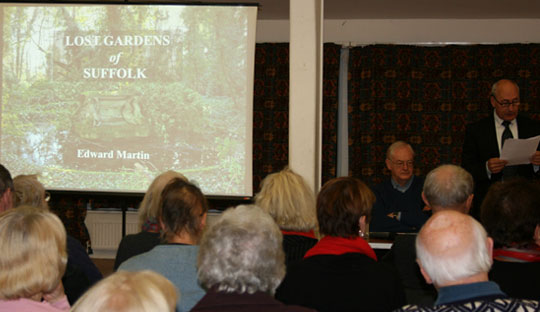
Edward Martin on 'The Lost Gardens of Suffolk'
A large audience of members and friends of Nayland HortSoc and the Conservation Society gathered for their annual joint meeting.
This was illustrated by a very sophisticated and entertaining graphics display featuring the use of dovecotes with water features, fountains, lakes and man-made garden canals, of which there were 50 in Suffolk gardens in the 17th and 18th centuries. The great period of garden creation was in the 18th and 19th centuries but medieval gardens, such as the one at Clare Castle, now lost, were also an important part of the landscape. The Clare Castle garden was created by Elizabeth de Burgh, “The Lady of Clare” dated from the mid 14th century. |
 |
| |
Edward Martin explained that before flower beds were introduced into gardens the fashion was to have colourful fabled beasts on posts holding banners throughout the “closgarden” near to the house, which brought year round colour to the gardens. Often a dovecote would be in the centre of a moated area.
Edward concluded his talk by showing how the garden plan for Tendring Park, Stoke by Nayland, which has now disappeared, can be traced from contemporary maps and the plans of Humphrey Repton. The Tendring canal was installed before 1723 and restored in 1992. The Temple or Fishing House (on the B1087 between Nayland and Stoke by Nayland) dates from 1750.
Other famous gardens included those of Blundeston Lodge a “sylvan delight”, which is now HM Prison. Sudbourne Hall gardens have disappeared under encroaching woodland. |
| |
|
|
| |
10th October 2016 |
|
| |
Court Knoll - Past, Present and Future' Dr Tim Dennis and the Survey team.
A fascinating account of the Court Knoll Project and its findings was heard by members of Nayland with Wissington Conservation Society at their October meeting.
The project, which has involved digging six trenches on the Knoll, has revealed all kinds of discoveries including pieces of Tudor plates, Roman tiles, animal bones, medieval fragments, oyster shells and two silver coins.
Chairman Mike Hunter said the dig was of national importance and would not have taken place without the drive and enthusiasm of the society’s secretary Andora Carver, who had taken part in the exercise daily with her husband James. |
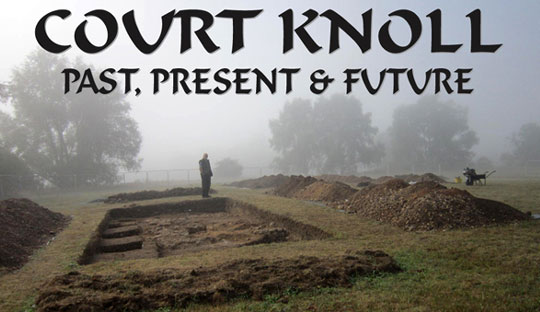
Click to view the photo album of the excavation carried out during September and October 2016 (pdf 5Mb)
|
| |
Started on September 2, he said the dig was backed by Suffolk Archaeology and was due to end on October 16. There had been a huge response from volunteers, both from Nayland and outside the village. The society was grateful to the Tendring Hall Estate for permitting the dig and Blue Owl who provided free bottled water.
Detailing the cost of the project, Mr Hunter said the society would be looking for further financial assistance for the next phase and he hoped the Dedham Vale Project and Nayland Community Council would make more funds available.
Dr Tim Dennis screened numerous slides illustrating how work on the Knoll had progressed in the various trenches and the specialist equipment used.
Mrs Carver said the project had followed a successful test pit dig in November 2014. She showed a selection of photographs and thanked all the volunteers. More than 70 people of all ages had applied and between 10 and 18 helpers were on site daily.
Visitors had included representatives of Historic England and the Tendring Hall Estate, two classes from Nayland Primary School and Dr Ronald Blythe. Among the finds were two silver coins – one dating probably from 1216 – and the other a Tudor penny.
All the finds will be analysed and Mrs Carver added she hoped one day to repeat the exercise.
Former chairman John Alexander presented Dr Dennis with a gift from the society and gave a vote of thanks to everyone involved in the Court Knoll Project. |
| |
|
|
| |
27th June 2016 |
|
| |
Further Reminiscences of Nayland and Wiston village life, compered by Chris Hunt.
The Society's chairman, Mike Hunter, introduced Chris Hunt, who is the third generation of Hunts in Nayland. His career was with the Fire Service. He is a bell ringer (Church Tower captain) and member of the Royal British Legion.
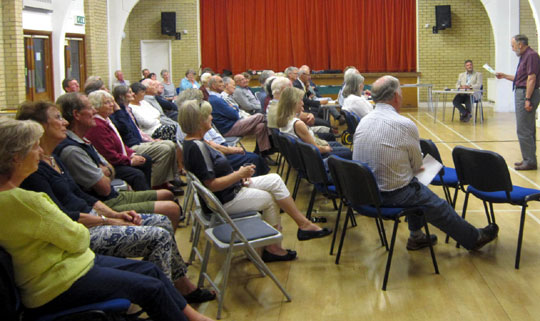
Chris's talk took the form of an illustrated walk round Nayland as it was, using archive photos, assisted by newspaper cuttings read by Peter Drew, giving descriptions of accidents and incidents in the village during the late 19th century, when there was much industry and no health and safety rules, until World War II. |
 |
| |
The village community was lively and self-sufficient with thriving shops, pubs, 3 dairies, 3 petrol stations (but with no motor cars), the Mill and 3 bakeries. 2 lorry firms and a bus company operated from 5 sites in the village. Accidents were common and included runaway horses, drowning while fishing and being crushed in the Mill.
David Slater then talked about Shaddelows Farm where his father took the tenancy in 1958. Although the farmhouse is in Stoke Parish, much of the land is in Nayland. He explained that the Anchor Marsh initially had cattle grazing but in the 1960s it was ploughed up for potatoes. However, with more traffic in the village and the increase in the size of farm machinery, it wasn't practicable to continue and the land is once more low input grassland, for cattle grazing and sileage. Nayland now sustains both intensive and low input farming, which David considers is the right balance.
Peter read an extract from a newspaper report of the 1871 fire at Perry Farm (off Bear Street). The fire was put out by villagers using buckets of water because the fire engine had a leaky hose
and couldn't pump more than a trickle of water. A bugle was played to warn people of its pending arrival.
Short silent films of a 1951 British Legion parade at the Jane Walker Hospital, included shots of Dr. MacMichael, the village GP and Hospital Medical officer, together with his wife and daughter, Shirley, who now lives in Stoke Road. Peter read out some of the strict rules and regulations for patients, which was an essential part of the treatment: pubs were out of bounds, walking exercise not allowed in parties less than three people. The second and fourth Sundays were visitors days, when Norfolks ran 5 buses.
Barges or Stour Lighters were shown at Wiston, Nayland & Horkesley Lock. The latter being the shortest distance apart on the whole of the Stour Navigation. Further descriptions of gruesome accidents and drownings were read by Peter. There were 7 wharves along Bear St, including coal and lime.
The annual Nayland National School treat was reported in 1867 – a procession to the Meadow, fun and games and return to the Schoolroom at 4.30pm for tea, then back to the Meadow for more sports.
The final shot was of cows coming up Bear Street from Parkers Farm.
Chris then read some memories of a Nayland resident whose family owned the dairy and bakery at the Old Guidlhall.
Val Munson spoke about her wartime memories of the plane crash in the field beyond Court Knoll, Tendring Hall where the Italian prisoners of war were billeted.
Sally Bartrum talked about living at the Anchor Inn as a child, her parents John and June Curtis took over the pub in 1956 until 1983. In addition to the two bars the inn had 4 large letting rooms, among the many people who stayed there were holiday makers and fishermen, farming students, parents visiting their sons at Windyridge, Flatford Mill artists and also a number of families who were looking for properties in the area. As many as 12-14 people could be accommodated at full board, with all the produce used sourced from the village shops.
Wartime memories included the installation of 4 mortar positions in the village which was a “Nodal” point, not an official “stop line”, but of importance being on a road and river crossing.
The Home Guard prepared the Anchor Bridge for demolition, but forgot to remove the explosives which were found later. A doodlebug crashed one night destroying a house at Nags Corner. It was later dredged up and after storage in the Carvers Barn, was found a home in an Essex Museum.
Tom Gardner gave a very interesting Vote of Thanks, with further memories of life in Nayland since he arrived 46 years ago as a 7 year old boy. He commented about the loss of so many business and pubs since that time and said it is so important to cherish and share all these memories, for future generations. |
| |
|
|
| |
Monday 14th March 2016 |
|
| |
Annual General Meeting
Speaker: Anna Moore of the Colchester Archaeological Group on 'Bures Cropmarks'.
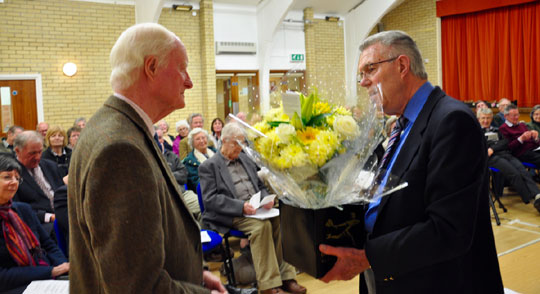
It was John Alexander’s last meeting as chairman; he was presented with a gift token issued by Snape Maltings permitting him to book concerts of his choice and flowers for his wife Olga.
Anna Moore of Colchester Archaeological Group then gave a really fascinating talk about Bures Cropmarks which the group have been studying since 2011. Their book, The Stour Valley: A Prehistoric Landscape is available from Nayland PO price £5. Anna began by stating that Cropmarks indicate what was going on under the soil in pre-historic times whereas Crop circles are made by tractors in fields of growing crops. |
 |
| |
In about 8,500BC the ice started to melt from the last glaciation and hunter-gatherers started visiting The Stour Valley, which is wide and shallow with the river running through. In ancient times the river was more of a highway than a barrier as it is now and there have been several changes in its course. Evidence of an older course running further south at Wormingford shows in aerial photos. The oldest man-made feature is a longbarrow, which shows as a pair of parallel ditches dating to 4,000 BC with lines of post holes on 1 side. Although the acid soil has destroyed most organic matter, it is thought it was used to lay out bodies, which were left to decay. The Bures cursus, or ceremonial way, is 190 metres long; another cursus at Wormingford is aligned with the sunrise and sunset at the solstices. From about 2,000 BC, smaller circular mounds were used for burying the dead in cremation urns which were usually inverted i.e. to return the bodies to the ground.
Anna also commented on Wormingford Mere, a significant piece of water called a kettle hole, left from the last ice age. Pre-historic people considered water to be the entrance into the underworld and this could be the reason that this part of the Stour valley was much used for rituals.
Anna finished by showing some aerial photographs of the valley. Martin Wright gave the Vote of Thanks, referring to the change in the landscape by nature and man – with mystical elements of the Solstice. |
| |
|
|
| |
Monday 9th November 2015 |
|
| |
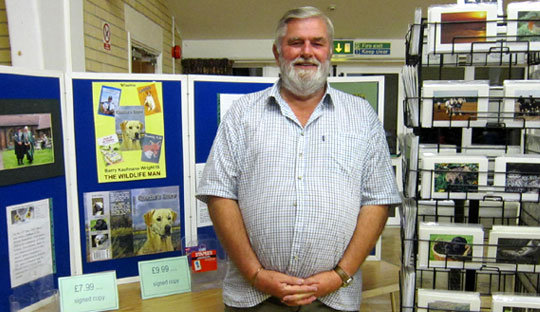
We ended 2015 on a high note with a splendid talk by Barry Kaufman-Wright on his many experiences in the role of a Police Wildlife Officer. There were some sad stories which did not always have a happy ending, especially involving horses, ponies and badgers. Barry spared us the sight of some of his more graphic photographs, which he explained were used in Court Prosecutions.
Barry is proud to be a member of the British Naturalists Association whose ranks include Sir David Attenborough. He started his career at Jersey Zoo where he met and worked with Gerald Durrell and has been a keen wildlife photographer for years and now has a collection of 72,000 slides. |
 |
| |
The audience were amazed to learn that he gives 200 talks a year on varying subjects connected with wildlife and his work with the Police. He explained that bats, great crested newts and badgers are all protected under the law as are all our native birds but non-native birds are not. Herons cannot be shot. Stealing native bluebell bulbs can result in a fine of £1,000 per bulb.
He left the audience with much food for thought and it is reassuring to know that the Police Wildlife Unit is ready to prosecute when acts of cruelty to animals and birds are discovered. Hopefully we will welcome Barry back for another talk in the future.
This annual meeting with Hortsoc has become something of an institution which benefits both our groups.
The photograph shows Barry with a selection of his photographs sold as greetings cards and Christmas cards. |
| |
|
|
| |
Tuesday 13th October 2015 |
|
| |
Speaker: Rosemary Knox on Why Study Wiston? Its Medieval Manor and Church
Rosemary Knox gave a fascinating insight into the reasons to study Wiston at an Open Meeting of the Conservation Society in Nayland Village Hall.
Thanks to Rosemary’s research into the manorial rolls dating from 1352, we were able to visualize life in Wiston with some wonderful examples of agricultural practices, such as growing oats and barley together for animal feed and an illustration of harvesting by glove-wearing labourers.
In the second part of her talk, Rosemary focused on the life of the remarkable Revd. Charles Birch, Rector of Wiston from 1832, who spent his whole life as a parish priest at Wiston and died aged 81. He is buried in the churchyard. He was obviously a very charismatic man who raised enormous sums of money to restore the church including the installation of a barrel organ, which is still in working order. He is probably best known for uncovering the wall paintings but covered them again as he thought them distracting to the congregation during his sermons. They were uncovered again in 1932.
The audience of Society members and friends thoroughly enjoyed Rosemary’s excellent talk which will no doubt encourage more visitors to Wiston Church. |
| |
|
|
| |
Tuesday 30th June 2015 |
|
| |
Speaker: Professor Jules Pretty on The Edge of Extinction – Travels with enduring People in Vanishing Lands
Prof. Pretty identified 5 locations from those covered in his book where indigenous people are under threat: Northwest Australia, China, Central Asia, Finland and the Swamps of the USA. This is due to commercial activity, climate change and the resulting loss of their ancient ways of life. He described the landscape and lives of these indigenous people and the fact that they view time as being circular, all in the context of “now”. Past and present being continually linked as in the Dreamtime of the Aborigines.
In northern China 30,000 people visit the Hua Shan mountains, where there are no roads, climbing 3,000 steps per vertical mile hauling up everything required for building and their daily existence. They do it because they can.
In Finland the ice now forms later and melts earlier thus shortening the Vendace fishing season of the traditional people.It takes 6 hours to pull in the nets by hand, which is the traditional method used by the fishermen standing on the ice.
In the swamps of Louisiana, Spanish Moss and epiphites were sold to the Ford Motor Company until the 1960s and used to stuff upholstery.
10,000 years ago Death Valley was fertile. The local trees are up to 4,000 years old. Their trunks much twisted by lightning strikes.
He went on to say that: “the sense of calm and peace with nature in a landscape is being lost as we all rush around. Having more “stuff” does not make us happier, neither does being wealthier.” He added it has been shown that the measurement of happiness is not wealth, it is lifestyle. Volunteers live longer. Giving time for others creates a feeling of well-being. Physical activity delays dementia by 10 years. Walking turns short term memories into longer ones and by connecting to nature we have a sense of place and the land. Loneliness has the same effect on the body as smoking 15 cigarettes a day.
In his view, the world does not have a population problem, it is a consumption problem. We use resources because we think they will make us happier, which they won’t.
In answer to a question about the use of GM crops, Prof. Pretty said he viewed pesticides as a bigger danger, along with discarded plastic in the oceans which will not degrade for 1,000 years or more.
The Edge of Extinction is published by Cornell University Press price £17.50.
Jules Pretty is Professor of Environment and Society at the University of Essex. |
| |
|
|
| |
Tuesday 9th March 2015 |
|
| |
Annual General Meeting
Speaker: Marcia Whiting 'Sir Alfred Munnings - with special local interest'
Over 60 members and friends were present in Nayland Village Hall when Marcia Whiting from The Munnings Museum at Castle House, Dedham gave a fascinating illustrated talk about his life and work.
Many lovely examples of Munnings’s skill were shown illustrating different phases and styles throughout his career.
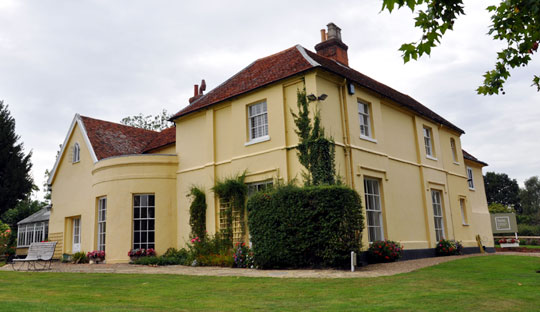
Sir Alfred Munnings was a gifted artist from childhood and in his teens lost the use of his right eye through an accident, which meant he had to learn how to handle the brush to canvas technique all over again. |
 |
| |
Horses and the countryside were his favourite subjects. “The Gipsy Fair” at Dedham being a notable example. His time at Lamorna with the Newlyn artists’ colony resulted in coastal subjects and Dartmoor also featured.
In World War I he served with the Canadian army and produced some powerful spontaneous images of the battlefield, including cavalry charges.
He perfected the art of Horse Portraiture which was a lucrative sideline after the war. A notable example being that of General Jack Seely on Warrior.
Marcia ended her talk by showing some works depicting the Dedham Vale and Stour Valley some of which are unframed and not generally on show. She very kindly extracted them from the archives to show us. “Floods at Nayland” being the last and most evocative interpretationof our local landscape.
It was a memorable talk and as a result a Private Visit for Conservation Society members to Castle House has been arranged for 5th May from 2pm to 4pm. The cost is £10 each to include a view of the house and gardens with tea, coffee and biscuits. To reserve a place please contact the Hon. Secretary: carversnayland@talktalk.net before April 1st. |
| |
|
|
| |
Monday 10th November 2014 |
|
| |
Joint Meeting with Nayland Hortsoc, Matt Holden, River Stour Officer, Dedham Vale & Stour Valley Project "The River Stour"
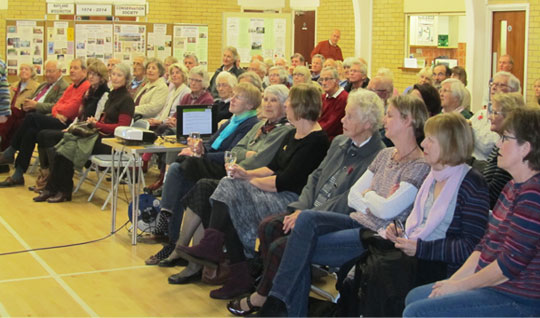
About 80 members and friends enjoyed a fascinating insight into the work done by the Dedham Vale Project and their partners in enhancing and protecting our local river and its tributaries for the benefit of wildlife and those who live, work in and visit the Dedham Vale.
Matt explained that The Dedham Vale Project and the Environment Agency have joined in a project, the driver of which is the Water Framework Directive of 2003. This is intended to broaden understanding of our lowland river system, to retain the navigation, increase the natural diversity of wildlife in the rivers and on the banks and their settings which inspire people in many different ways. |
 |
| |
Fish stocks are naturally of great concern and Nayland is classified as “middle Stour” with the fast moving water over gravel beds south of the Anchor Bridge being good for fish breeding. Otters, eels and kingfishers have also been seen locally and add to the varied habitat and the joy of spending time near rivers.
Volunteers have also surveyed the river at Higham. Over 6,000 features have been recorded along the Brett, Box, and the Glem which are part of the River Stour system.
Pesticides, herbicides and sewage treatment works have adverse impacts on river life. In August thousands of fish died due to a leakage of untreated sewage at Haverhill. Abstraction also impacts upon water flows.
The public are encouraged to report the presence of non-native invasive species along riverbanks and to volunteer for “balsam bashing days” Himalayan balsam, Japanese knotweed, giant hogweed, floating pennywort, water primrose, are amongst the most virulent to watch out for. Further information is available on the Dedham Vale Project website.
Woody debris, if cut back sufficiently to allow canoes to pass, is a valuable habitat for mammals, ducks and fish, protecting them from predators. It should only be cut back if there is flood danger to people and property. Matt highlighted the importance of retaining the growth of native species along the riverbank wherever possible because it creates valuable cover for water voles, nesting waterfowl and birds. In answer to a question Matt stressed that cutting back nettles and bankside weeds leaving a bare surface is not recommended.
Mike Hunter gave the vote of thanks and Matt was invited to draw the raffle. |
| |
|
|
| |
Monday 13th October 2014 |
|
| |
Speaker: Leigh Alston: "Nayland's Timber Framed Buildings"
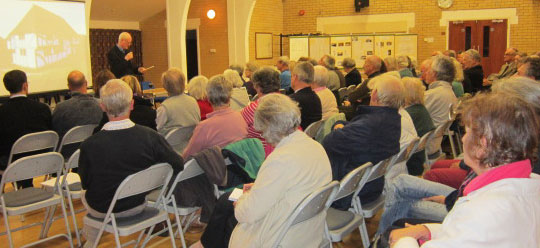
Over 80 people packed into Nayland Village Hall to welcome back Leigh Alston and hear from him some more fascinating insights into what makes Nayland’s timber framed buildings so very special and different to Lavenham, Coggeshall and other well-known medieval villages. |
 |
| |
He explained how the medieval house plan worked and that the same layout percolated through Society from the highest to the lowest status buildings. The central hall, heated by an open fire was the living space with buttery and pantry at the “low” end with floored storage space above. Nayland’s smallest open hall is in Fen Street (9ft. long).
Alston Court, whose right hand cross wing roof timbers have been dated to c.1290, is one of only 2 or 3 surviving 13th century 2 storey timber framed buildings in the country. It is Grade 1 listed and undoubtedly the premier building in the village.
Several features of the building are unique, particularly the fine oriel window of c.1520 with its decoration of exotic animals and highly decorated mulllions, which probably survives in such good condition because for many years it was plastered over.
Leigh explained that recent research on the armorial stained glass windows of the Abell & Payne families have found them to be authentic and date to between 1490 and 1500.
He has recently excavated under the present floor in the great hall and showed photographs of the layers of beaten clay with clear streaks of black soot at the various levels where the clay, broken pottery and animal bone trodden into the surface, built up over several hundred years.
One of the unique features of Nayland is the high number of medieval semi-detached renters, which were built on the Wealden Plan whereby the roof spans both jettied ends of the hall (eg. 10-12 Birch St.) Smoke from the bonfire in the hall penetrated through roof tiles or shingles and was controlled by adjusting the angles of window shutters. Church House is also a good example and had a very narrow hall between the jettied ends.
The Queens Head dates from the late 14th – early 15th century with a grand 16th century parlour at the rear. The ogee shaped service doors of c.1375 can be seen through the arch off the street.
The Guildhall was built c. 1530 only a few years before the Reformation (c.1537) and it is interesting to note that Guildhalls were often built next to Inns. The ground floor was for domestic use and the Guild would use the upper room. Entertainment took place at the Inn.
Leigh has a theory that Nayland’s 13th century market place originally spread as far north as Fen Street. Later medieval markets were triangular with a narrow entrance to take tolls.
Church Mews, c.1530, was built in the heart of the market place very close to Alston Court. Traces of the oriel windows with clerestoreys each side can be seen from the interior. There is also evidence for brick noggin between the timbers, similar to Alston Court. It would have been a very fine merchant’s house with courtyard at the rear.
He also touched on wall paintings, and showed examples of several brightly coloured designs from Nayland buildings.
By the 17th century re-used timber was being used in framing which tended to be covered with plaster. The cartouche dated 1690 on the outside of 6 Bear Street is original.
The accompanying excellent pictures gave the audience a brief glimpse into the medieval world and the extreme contrasts between the wealthy cloth merchants and the artisans who lived in tiny rented cottages.
Leigh is working on a book about the Timber Framed Buildings of Nayland and his recent researches will be included along with information gained when surveying over 70 timber framed buildings in 1999-2000 while preparing A Walk Around Historic Nayland. It is hoped that the book will be published in 2015 by the Conservation Society. |
| |
|
|
| |
Monday 10th March 2014 |
|
| |
Annual General Meeting
Speaker: Paul Gallifant “The Dedham Vale AONB - Worth Fighting For”
This year the Society is celebrating its 40th Anniversary and at our AGM John Alexander outlined the origins of the formation of the Society.
In 1974 a small group of people, led by Blair Lees, Nayland’s Parish Recorder and editor of the Nayland Record, and including Wendy Sparrow, realised that Nayland was a special village, both scenically and historically and decided to ask residents if they were interested in forming a “preservation” society in Nayland. Now, 40 years on we can be justifiably proud of its achievements, particularly in protecting against adverse development. The Society has more than 250 members – a remarkable record considering the size of the village.
More than 70 members and friends attended the AGM on 10th March when Paul Gallifant, a member of the Dedham Vale Society Committee, showed a wonderful selection of beautiful photographs of Nayland and Wiston in the 1970s and the Dedham Vale through the seasons. It is most certainly worth fighting for as the title of his talk suggested.
Officers and Members of the Committee were elected for 2014/15 as follows:
Chairman: John Alexander Vice Chairman: Martin Wright
Hon. Treasurer: David Heigham Hon. Secretary: Andora Carver
Committee: Jennie Jenkins, Jill Slater, John Partridge, Mike Hunter and
Bill Starling.
The Chairman thanked retiring Committee members, Pauline Heigham and Clemency Doxey for their hard work and support and welcomed David Heigham and Bill Starling, who is representing Wiston. |
| |
|
|
| |
Monday 11th November 2013 |
|
| |
Speaker: Dennis Dungey,
President of North East Essex Badger Group on 'Badgers'
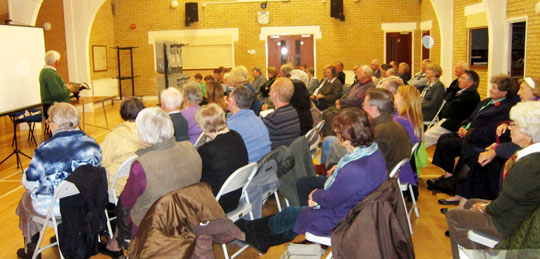
At the joint meeting with the Horticultural Society Dennis Dungey spoke to about 60 members and friends in the Village Hall. He told us some fascinating facts about the private lives of badgers and some useful tips on badger watching and how to identify “live” badger setts from hairs left on the surface when the animals changed their bedding from underground and groomed each other. |
 |
|
| |
They are very clean animals and do not feed underground, unlike foxes. Their range is sometimes very extensive and their setts have many entrances for safety and historic reasons.
Dennis explained the pros and cons of culling badgers to control bovine tb and felt the solution lay in vaccinating cattle. He thought that the badgers which are being culled should be tested for tb to find out what proportion of them actually are carriers.
He asked everyone to report seeing dead or injured badgers by the roadside because they are often found close to their “runs” and this can help the Badger Trusts identify where individuals have come from. There are Badger Groups throughout the country.
The Badger Hotline number is 07751 572175 and is open 24/7 |
| |
|
|
| |
Monday 14th October 2013 |
|
| |
Speaker: William Starling on The Jane 'Walker Hospital – recent history'
About 50 people, including many Wiston residents, were in the Village Hall last night to hear Bill Starling talk about the recent History of the Jane Walker Hospital. He began by revealing the reason that a collection of conifers were planted near the hospital. This was part of Jane Walker's regime of healthy fresh air assisted by the scent from the pine trees.
The building was designed by Smith & Brewer, architects, in the Arts and Crafts style and built in 1898.
Following its closure as a tuberculosis hospital, it was taken over by the the local authority in 1948. In 1959 it was renamed the Jane Walker Hospital and, under the National Health Service, became a hospital for the mentally handicapped.
The hospital closed in 1991 and the Hospital, Chapel and Boiler House were listed Grade II in March 1992. It was later converted to 8 dwellings with the first residents moving in in 1997. Bill then spoke about the benefits and drawbacks of sharing a listed building and the importance of good management and "getting on with the neighbours". The benefit being that all could share in a wonderful building and its grounds. The downside of communal living being the organisation of maintenance, regular exterior painting at the same time using designated colours and paint brands and of course the service charges. |
 |
|
| |
|
|
| |
Monday 24th June 2013 |
|
| |
Speaker: John Rix, Farming in the Stour Valley
Formal Business:
The necessity to vote on two small amendments to the Society's Constitution meant that our regular Open Meeting on 24th June became a Special General Meeting. These changes relate to approval for the acquisition of items of historic or public interest in the area of benefit and give powers to the Society through the Executive committee to acquire and hold any feature or object of historic or public interest relating to the area of benefit. Members present voted unanimously for the first amendment and by more than the required two thirds majority for the second amendment (48 approx. in favour 1 against and 2 abstentions).
The Chairman reported on a successful Open Gardens. There were 16 gardens open and a surplus of £2,500 was achieved which will go towards the funding of a second Nayland Test Pit Dig in Sept/Oct 2014. The chairman also reported that the Committee have applied to the Community Council for a grant of £1,500 towards the £8,000 required for this project.
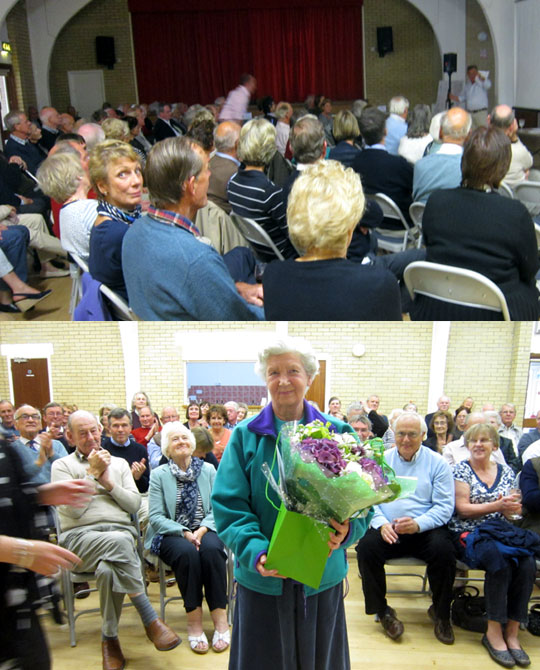
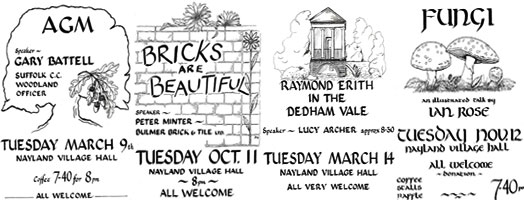
A floral presentation was made to Jean Dryden in appreciation and recognition of her great contribution to the Society over the past 30 years of drawing and painting the Society's posters for meetings. Examples of her work were displayed. (See photo)
In his report, John Alexander, stated that the Horkesley Park Appeal Hearing is to be in October with 2 weeks at Langham Village Hall and the final 2 days at the Moot Hall, Colchester. Whatever the outcome of the Appeal the Secretary of State will make the final decision.
|
 |
| |
John Rix then gave a fascinating insight into "Farming a Masterpiece".
P G Rix (farms) commenced farming at Great Horkesley in 1950 on a 28 acre dairy farm which was a wedding present to John Rix's late father and mother and has grown to over 5,300 acres today. The family business provides farming services to 18 different landlords from Bures to Dedham along the Stour Valley and employs some 130 people, the majority of whom live in the local area.
The very geographical nature of the Stour Valley offers a wide variety of opportunities and challenges, with a diverse range of soil types and topography.
Crop production includes Winter Wheat, Winter Barley, sown in the autumn and Onions, Potatoes, Lettuce, Sugar Beet and Linseed sown in spring.
Onions are grown on 900 acres to produce about 18,000 tons which provide an 11 month supply to their packhouse, Stourgarden, for direct supply to Tesco.
Rix Farms also produce 16,000 tons of various types of potatoes which are lifted from June to September . With their cold storage facility they provide a potato supply for 10 months of the year to their customers.
Historically the restrictions of water courses, roads and topography prevented the wholesale removal of hedges and the average field size over the 5,300 acres farm is still only 24 acres which is relatively small for modern arable farming.
Pedigree herds of South Devon and British Charolais graze over 400 acres of grassland adjacent to the River Stour and on the less productive steep hills on the valley escarpment.
200 acres of field corners, pollen nectar strips, wild bird covers, un-harvested cereals and grass margins are annually managed under the government's Higher Level Stewardship Scheme.
Hedgerow planting and management to replace dying elm coppice has involved 14 kilometres in the last 10 years. In 1960 48% of mature standard trees in the Stour Valley were elm.
The Farm Woodland Scheme has supported Rix farms in planting and managing 35 acres of new woodlands on their land.
John Rix ended his talk by saying that the last two years has seen the most extreme weather conditions we have ever experienced with the drought of 2011, followed by the monsoon summer of 2012, a wet winter and in 2013 the coldest spring on record. Farming is now more interesting and challenging than ever. |
| |
|
|
| |
Monday 29th April 2013 |
|
| |
The Results of the Nayland Test Pit Digs
Dr Carenza Lewis,
Access Cambridge Archaeology
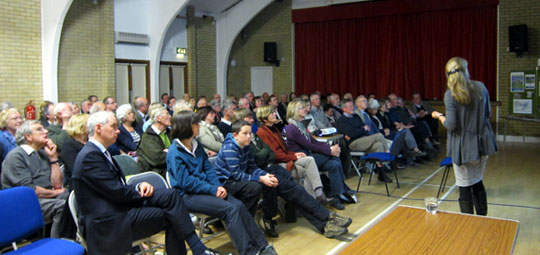
There were almost 100 people in the Village Hall on Monday 29th September to hear Dr. Carenza Lewis's review of the Results of the Nayland Test Pit Dig which took place last October. The audience included volunteer diggers from outside the village along with site owners, representatives of Nayland Primary School, the Parish Council and the Nayland Scouts.
|
 |
| |
Dr. Lewis described the finds from each of the 33 pits which have been analysed by experts at the MacDonald Institute for Archaeological Research at Cambridge and an interesting picture of the origins of Nayland has emerged.
There is evidence of Roman activity in the form of shards found in undisturbed layers on the west side of the village, near to the A134/Bear Street junction and then on the Stoke Road in the east but nowhere in the village centre.
There were only 2 sites in the village showing evidence of the late Anglo Saxon period (Thetford Ware), one of which was not far from Court Knoll which is thought to be a Norman moated site.
The grand finale of Dr. Lewis's fascinating talk was to discover how the Nayland finds compare with average finds of each period in the context of the bigger picture in East Anglia.
- 6% of Nayland pits produced 2+ sherds of Roman pottery (regional average is 7%);
- 6% of Nayland pits produced 2+ sherds of Late Anglo-Saxon pottery (c. 850-1100 AD) (regional average is 9%);
- 50% of Nayland pits produced 2+ sherds of High Medieval (c. 1100-1350 AD) pottery (regional average is 35%).
- 72% of Nayland pits produced 2+ sherds of Late Medieval (c. 1350-1550 AD) pottery (regional average is 19%).
- 76% of Nayland pits produced 2+ sherds of Post-Medieval (c. 1550-1800 AD) pottery (regional average is 51%).
The general feeling of the meeting was that we should arrange another smaller dig in the future to advance our knowledge of the origins of the village, if funding can be found. It would also be good to dig some test pits in Wiston. |
| |
|
|
| |
Monday 11th March 2013 |
|
| |
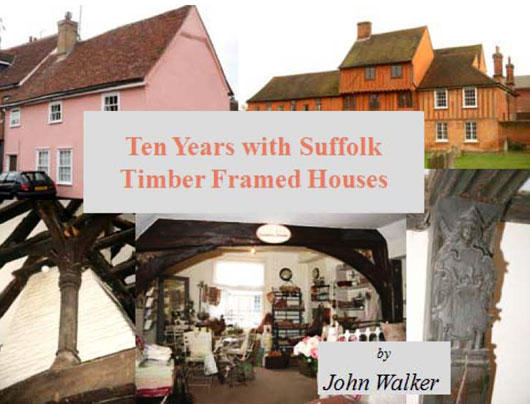
Speaker: John Walker, architectural historian: Ten Years with Suffolk Timber Framed Houses
John Walker gave a really fascinating talk.
His presentation cleverly showed how buildings have evolved over the centuries and what they would have looked like in their original form. He also highlighted the difference between the framing styles of North and South Suffolk. For instance, chimneys tended to be at the High End in North Suffolk and in South Suffolk they were at the Low End of the building.
He showed us several buildings in Hadleigh, particularly those in the High Street, where the wall tiles in the butchers shop hide the original timber studwork and what appear to be Victorian brick built houses are actually medieval timber framed buildings with a brick outer skin. He went on to demonstrate the development of kitchens which were attached to the house and often had no windows and no direct access to the main house. Evidence of this was clearly seen in photos of partly sooted roof timbers. Inventories with descriptions of buildings are also used to identify what the original structure looked like which helps to show what elements have been lost.
|
|
| |
13th November 2012 |
|
| |
Speaker: Neil Catchpole on 'Trees and the Stour Valley'
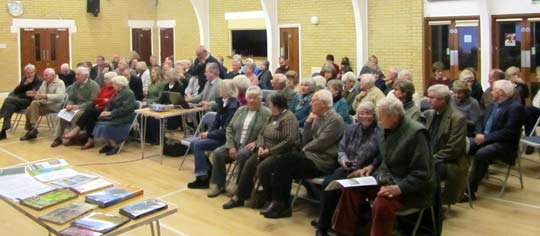
About 90 people were in the Village Hall to hear Neil Catchpole, Landscape and Biodiversity Officer of the Dedham Vale AONB and Stour Valley Project give a fascinating talk about the Trees of the Stour Valley at our Joint Meeting with the Horticultural Society on November 13th.
He explained the difference between pollarding and coppicing and how these methods of controlling tree growth are suited to different species. i.e. ash, oak and willow can be pollarded, but hazel and elm are more suited to coppicing which also helps to control the beetles which spread Dutch elm disease. The local hotspot for ash dieback is Arger Fen and he advised the best method to deal with this airborne disease is to rake up and burn ash leaves in gardens and woods which will help to stop the spread of the fungal spores.
Neil's talk about trees in the Stour Valley was booked over a year ago, and how topical it turned out to be.
|
|
| |
9th October 2012 |
|
| |
Speaker: David Cawdell on
'The Lost Bands of Suffolk'
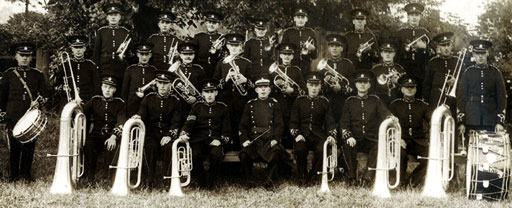
There has been a huge reduction in the number of brass bands not only in Suffolk but in the country generally. To a large extent this has arisen as a result of the population migrating to towns from the villages and the consequent reduction in the rural population. David's research was quite extraordinary. Working from old photos of bands (sometimes obtained on the internet) he has managed to trace former band members to obtain their memoirs. Highlight of the evening was the production of a band jacket which had featured in the film "Brassed Off" …..purchased on Ebay for an undisclosed sum!
|
 |
| |
26th June 2012
|
|
| |
Speaker: James Grinter
on 'Royalty and Reemans'
About 60 members and friends heard the fascinating story of how Reemans came to be the only auctioneers in the country to have specialist royal sales. James Grinter said it all started 4 years ago when they were asked to sell the contents of William Tallon's flat. He was the Page to the Backstairs to Her Majesty Queen Elizabeth The Queen Mother and had been with her for 51 years until her death in 2002. During this time he had saved numerous notes, letters and photographs, some of which made several hundred pounds auction in 2008. The collection realised a total of £440,000.
James told us that Reemans have a mailing list of 700 people from all over the world who bid on line, on the telephone and in person, at royal sales. He showed photographs of an red investiture chair which made over £100, and several photos of the Duke of Windsor.
|
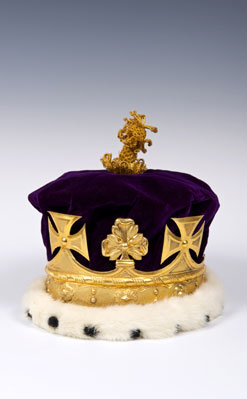 |
HRH Princess Louisa Duchess of Connaught and Strathearn - rare Royal silver gilt coronet made by Garrard & Co for Her Royal Highness for the coronation of King George V comprised of a silver gilt circlet of interspersed crosses and strawberry leaves (two missing), chased with jewels with Royal purple velvet cap with gold bullion tassel and white and black spotted ermine headband and white silk lining contained in its original Garrard & Co leather case with silk lining and sliding pad with ring handle and brass plaque engraved HRH The Duchess of Connaught Coronet (hallmarked London 1911).
Princess Louisa was a German Princess born in Potsdam in 1860. She married Queen Victoria's youngest son Prince Arthur Duke of Connaught and Strathearn in 1879. Throughout their married life she accompanied her husband on many official duties in all parts of the Empire and was Viceregal Consort of Canada from 1911-1916. They lived at Bagshot Park, Surrey (currently the home of HRH Prince Edward, Duke of York) and Clarence House, London where the Duchess died prematurely at the age of 57 from influenza on 14th March 1917. She was the first member of the Royal family to be cremated and her ashes are interred at the Royal Burial Ground at Frogmore.
(Hammer price £2000.00) |
|
| |
In answer to a question as to which royal subject is currently the most collectable, he said that any letters, photos or objects connected to Princess Diana fetch the highest prices.
Meetings change: before the talk members approved the proposal to move all future open meeting to Mondays (from Tuesday) in order to accommodate the Nayland Youth Club who have booked the hall every Tuesday throughout the year from January 2013.
Meadow footpath cutting: Members were asked to let the Hon. Secretary know when the public footpath beside the river gets overgrown, so that it can be cut by our contractor. This might help to stop people using an unofficial track beside the fence which is damaging the wildflower belt and which was mistakenly cut by Suffolk County Council recently.
|
| |
Tuesday 13th March 2012 |
 |
 |
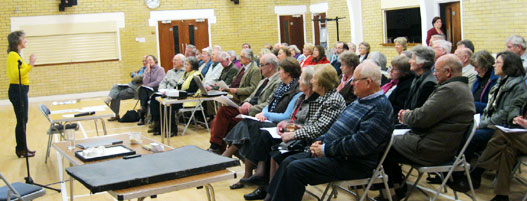
Anna Kettle gave an interesting talk on 'Pargeting'.
Images used with the
permission of Anna Kettle,
copyright Anna Kettle |
|
| |
Annual General Meeting
Speaker: Anna Kettle on 'Pargeting'
Martin Wright, as Vice-Chairman, stood in for John Alexander at the meeting which was attended by about 70 members and friends.
The White Hart continues to cause concern. The Society has adopted the Wiston kiosk which will be re-instated in Bear Street in due course. We supported the change of use of the Church of the Sacred Heart to domestic residence. Plans for our 40th anniversary in 2014 are already in hand. We are hopeful that the long awaited book by Leigh Alston on the timber framed buildings of Nayland, will be completed by 2014.
The Accounts were presented by the Hon. Treasurer and the Officers and Committee were duly elected. The Committee has lost Andrew Eldridge who stood down due to other commitments. |
| |
Richard Wiles was thanked for all his hard work on maintaining the planted areas near Horkesley Lock and the Nayland Meadow and in recognition of this we have decided to name the Meadow planted area Richard’s Wood, which he has graciously accepted.
In accepting the role of Life President, Barry Wakefield spoke about the importance of the Society’s Constitution and that he sees the Conservation area as an ongoing living entity. His words of thanks in accepting his election can be viewed on News page.
In her talk Anna Kettle explained that pargeting is really plastering with a decorative streak.
Lime plaster is used because as the timber frame moves the plaster moves with the timber. The lime is mixed with chalk and animal hair as a bond. Later in the 19th century, sand was also added. It becomes a sticky mixture and so can be moulded onto internal ceilings as well as walls.
Combs and wooden moulds were used to achieve the desired effect. Popular patterns include, the fan, woolskein, and basket weave. Colour was too expensive and often patterns were marked out in red or black.
Plaster in high relief needs support and on outside walls lead was used – or stainless steel today. First floor decoration was favoured because it was less likely to be damaged, so the ground floor walls were often left plain.
History:
The Assyrians first used pargeting – incised and built up plaster – to create different ways of creating shadows. The technique died out after the Romans and was not re-discovered until the Renaissance, when it was copied from Pompei.
Henry VIII brought the skill to England and his Nonsuch palace was a sophisticated example of Tudor workmanship. Blicking Hall in Norfolk has examples of panels showing mythical beasts entwined with strapwork (flat) ribbons of plaster.
The fashion died out during the puritan period but after Charles II highly ornamented Jacobean pargeting became more sophisticated. The Ancient House at Clare is a fine example of an almost complete free flowing pattern in high relief. The advantage being that the shadows thrown out are well defined in 3 dimensions, which is what makes pargeting different from painting. The Ancient House in Ipswich and houses in Hadleigh and Lavenham feature a mixture of freehand modelling of figures with additional details moulded on a bench and added later.
The fashion died out in about 1780 when timber framed houses were replaced with brick buildings.
There was a mini revival with the Arts and Crafts Movement in 1900 with plaster (and sometimes cement) panels being drawn into by hand. Latterly colour was used but the shadows do not show up and the effect is lost.
Anna Kettle specialises in lime plaster repairs, plaster conservation, freehand modelling in lime, overmantels and pargeting.
Pictures of her work can be found on her website: www.kettlenet.co.uk She can be contacted on Anna@kettlenet.co.uk |
| |
 |
|
| Tuesday 8th November 2011 |
 |
| |
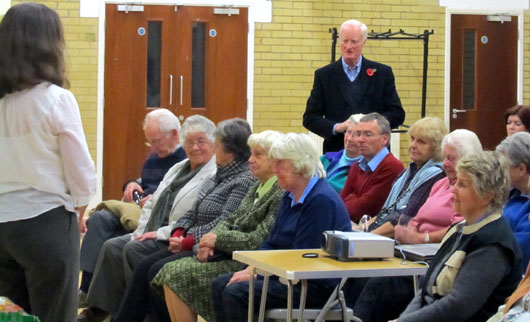
At the joint meeting with the Horticultural Society on Tuesday 8th November Shirley Boyle, head gardener at the RSPB Flatford Wildlife Garden, gave an interesting talk on Gardening for Wildlife. She also introduced the Flatford project, their first dedicated wildlife garden, which is coming to fruition on land bequeathed to the RSPB 10 years ago.
Shirley bagan by explaining that gardens make up 300,000 hectacres of land in Britain so making them wildlife friendly is vitally important and can help create corridors to enable safe wildlife movement. As well as providing year round food, water and nectar from flowers, it is important to provide good shelter and places to breed in the form of bird and insect boxes, log piles, hedges and shrubs. By encouraging the wildlife at the bottom on the food chain it will benefit the predators all the way up the food chain. We will be rewarded by having a diverse range of insects, birds and animals who will naturally help control pests on our plants. |
| |
|
|
| Tuesday 11th October 2011 |
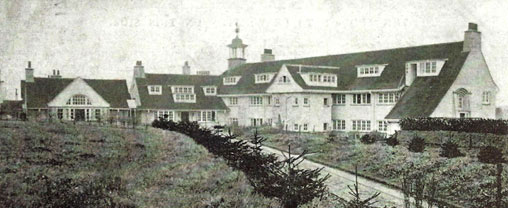
A very cultivated woman, she ran a London practice as well as the sanatoria which she visited twice a week up until her death in 1936. The East Anglian and the Maltings Farm Sanatoria continued without her until 1943 when both were bought by the British Legion to treat women with TB and they finally closed in 1957 when antibiotics produced a full cure for the disease.
|
| |
Speaker: Rosemary Knox
on 'Dr. Jane Walker and her hospital'
Dr Jane Walker was one of the early women doctors who had to qualify abroad. She studied the new German method of treating TB through diet, fresh air and exercise and was the first to bring it to England where in 1901 she founded the East Anglian Sanatorium at Nayland. Assisted by her friend Millicent Fawcett she eventually added both a sanatorium for working people and a children’s sanatorium and developed a system whereby patients were trained in useful skills and encouraged to work on the hospital farm when they were partially cured but not able to return to the outside world. |
| |
|
|
| Tuesday 8th March 2011 |
|
| |
AGM Report and talk on
The Tendring Hall Estate
Our AGM on Tuesday 8th March was one of the best attended ever with almost 100 people packed into the Village Hall.
The Officers and Committee were re-elected with the addition of Mike Hunter as a co-opted member as follows:
Chairman John Alexander, Vice Chairman Martin Wright, Hon. Treasurer Jennie Jenkins,
Hon. Secretary Andora Carver, Committee: Margaret Dowding, Pauline Heigham, Jill Badman,
Clemency Doxey, Andrew Eldridge. |
 |
| |
Hector Wykes-Sneyd gave a fascinating talk about the history of Tendring Hall and the Estate which comprises 3,000 acres of land and woodland, 45 buildings (including 25 listed buildings), 1 ancient monument and employs 3 full time workers.
The Manor of Tendring was mentioned in Domesday and in 1749 Admiral Sir William Rowley purchased the Estate. The family have owned it ever since. The house was designed by Sir John Soane in 1784 and built at a cost of £9,000. The park was laid out by Humphrey Repton.
The house was used by the army in the War and the decision was taken to demolish it in the 1950s because the cost of repairs was prohibitive. Unfortunately all that remains of the house today is the front door portico which is a listed building.
In 1968 Sir Joshua Rowley entered into a contract with the National Trust to protect the landscape and buildings.
Tenanted farms range from the highly technical production of onions and potatoes to
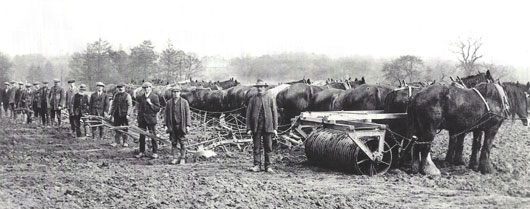
traditional farming using draught horses.
The water meadows are predominantly let for summer grassland grazing and there are also bat willow plantations which bring in a regular annual income. There is a 10- 20 year rotation with 150-250 trees being harvested annually.
The shoot has benefits for both estate vermin control and land habitat which results in very diverse birdlife on the estate. There is also a collection of veteran oaks on the estate which are several hundred years old. The woods are managed to produce final crops of largely oak and chestnut.
Redundant barns are conserved rather than demolished and the 17th century watermill at Thorrington Street is still in working order. There is an 18th century dovecote in the park and the estate has provided many local amenities including village allotments, a cricket ground, and a hardcore road from Shaddelows Farm to the A134 to relieve traffic in Nayland.
The ethos of the Trustees of the estate is to be aware of their obligations towards their tenants, staff and the local communities whilst operating a successful business to safeguard the Estate for future generations.
Hector Wykes-Sneyd gave a fascinating talk about the history of Tendring Hall and the Estate which comprises 3,000 acres of land and woodland, 45 buildings (including 25 listed buildings), 1 ancient monument and employs 3 full time workers.
The Manor of Tendring was mentioned in Domesday and in 1749 Admiral Sir William Rowley purchased the Estate. The family have owned it ever since. The house was designed by Sir John Soane in 1784 and built at a cost of £9,000. The park was laid out by Humphrey Repton.
The house was used by the army in the War and the decision was taken to demolish it in the 1950s because the cost of repairs was prohibitive. Unfortunately all that remains of the house today is the front door portico which is a listed building.
In 1968 Sir Joshua Rowley entered into a contract with the National Trust to protect the landscape and buildings.
Tenanted farms range from the highly technical production of onions and potatoes to
traditional farming using draught horses.
The water meadows are predominantly let for summer grassland grazing and there are also bat willow plantations which bring in a regular annual income. There is a 10- 20 year rotation with 150-250 trees being harvested annually.
The shoot has benefits for both estate vermin control and land habitat which results in very diverse birdlife on the estate. There is also a collection of veteran oaks on the estate which are several hundred years old. The woods are managed to produce final crops of largely oak and chestnut.
Redundant barns are conserved rather than demolished and the 17th century watermill at Thorrington Street is still in working order. There is an 18th century dovecote in the park and the estate has provided many local amenities including village allotments, a cricket ground, and a hardcore road from Shaddelows Farm to the A134 to relieve traffic in Nayland.
The ethos of the Trustees of the estate is to be aware of their obligations towards their tenants, staff and the local communities whilst operating a successful business to safeguard the Estate for future generations. |
| |
|
|
| |
|
|
|
| |
A selection of our unique posters, all of which are hand drawn and lettered by one of our members.
|
 |
|